
Compression instructions below
How do I reduce dsf size by a specific percentage?
-
Choose your file. To select the dsf file, you have two options:
-
Click "Select dsf file to compress" to open the file chooser
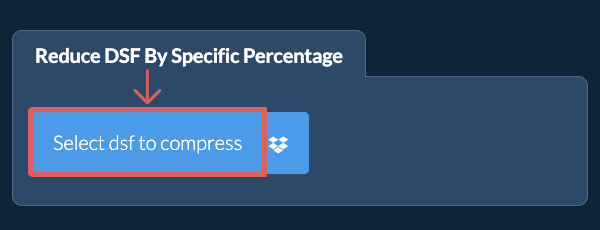
- Drag and drop the dsf file directly onto ezyZip
Click "Select dsf file to compress" to open the file chooser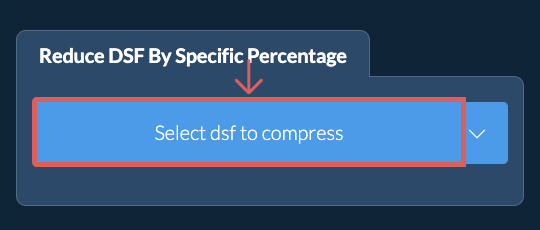
-
-
Compress the file.Click "Compress DSF". It will start the compression process which will take some time to complete.

-
Save the result.Click on "Save DSF File" to save the compressed DSF file to your selected destination folder.
-
Select from DropboxClick the down arrow (▾) next to the file selection button, then choose "Select from Dropbox".

-
Pick your filesA small ezyZip window opens. Click "Continue to Dropbox", sign in to Dropbox if asked, then pick what you want to compress.
-
Compress your filesezyZip downloads your selection into your browser. Then follow the instructions above.
-
Save to DropboxWhen your file is ready, click the down arrow (▾) next to the save button and choose "Dropbox". The first time, Dropbox asks you to allow ezyZip access.
Files are saved in the /Apps/ezyZip folder.
-
Select from Google DriveClick the down arrow (▾) next to the file selection button, then choose "Select from Google Drive".
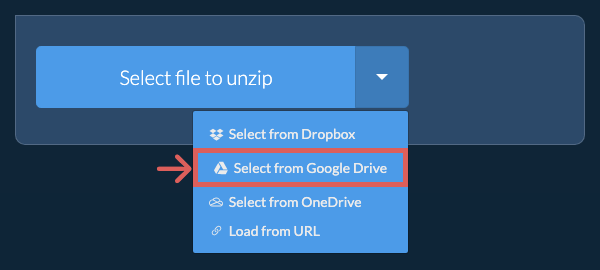
-
Sign in and pick filesA Google Drive window opens. Sign in to Google if asked, allow ezyZip to access the files you choose, then pick what you want to compress.
-
Compress your filesezyZip downloads your selection into your browser. Then follow the instructions above.
-
Save to Google DriveWhen your file is ready, click the down arrow (▾) next to the save button and choose "Google Drive". Sign in to Google if asked.
Files are saved in the My Drive/ezyZip folder.
-
Select from OneDriveClick the down arrow (▾) next to the file selection button, then choose "Select from OneDrive".
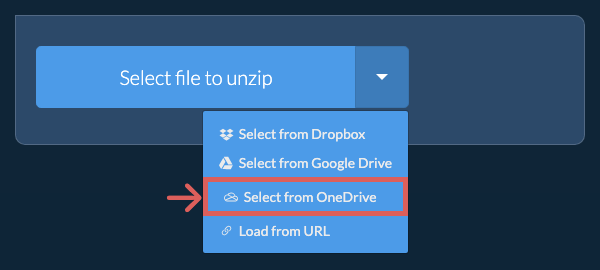
-
Sign in and pick filesA OneDrive window opens. Sign in with your personal Microsoft account if asked and allow ezyZip access, then pick what you want to compress.
-
Compress your filesezyZip downloads your selection into your browser. Then follow the instructions above.
-
Save to OneDriveWhen your file is ready, click the down arrow (▾) next to the save button and choose "OneDrive". Sign in with your Microsoft account if asked.
Files are saved in the Apps/ezyZip folder.
Frequently asked questions
We are continuously updating the system, so ensure you are using the latest version of one of the popular browsers or their variants. (e.g. Chrome, Firefox, Safari, Opera).
Please let us know via the feedback form if you have any issues.
ezyZip is a free online dsf to a specific percentage file size reducer that runs in your browser. No need to install any additional compression software. It supports a myriad of other media compressions too.
Unlike other online media compression utilities, ezyZip does not add watermarks or require uploading files to a server. Use it as many times as you want, completely free. It runs locally as a browser app, making it much quicker than other online conversion tools. This also ensures your privacy will be protected as no file data will leave your browser.
ezyZip processes files directly in your browser. Unlike most online tools, your files are not uploaded to our servers, which means faster processing and better privacy. Take a look at the feature comparison below and we think you'll agree that ezyZip is the better choice for your file conversion needs.
| Feature | ezyZip | Other Online Tools |
|---|---|---|
| No Software Installation | Works Directly in Browser | Works Directly in Browser |
| Processing Location | Your Browser (No Upload) | Their Servers (Upload Required) |
| Privacy & Security | 100% Private (Files Never Leave Your Device) | Files Uploaded, Accessible by Others |
| Processing Speed | Fast (No Upload/Download Time) | Slow (Upload + Process + Download) |
| Registration Required | Never | Often Required for Large Files |
| Works Offline | Yes (After Page Load) | No |
| Media Format Support | 200+ Audio/Video Formats | Limited (MP4, MP3 only) |
| Output Quality | Clean Output, No Watermarks | Watermarks Added |
| File Size & Usage Limits | 1GB Files, Unlimited Usage | 100-200MB, Daily Limits |
| Cost | 100% Free | Free with Limitations / Paid Tiers |
| Established | Since 2009 (15+ Years) | Recent (May Disappear) |
Why client-side DSF percentage-based compression is faster
ezyZip's WebAssembly media engine uses an adaptive bitrate algorithm to achieve precise percentage-based compression for DSF media. Here is why local processing is faster:
- Iterative Local OptimizationQuality margins are adjusted based on file size through rapid local iterations, without network latency per adjustment attempt. The algorithm performs a two-pass analysis — first scanning the media to assess complexity, then encoding with optimized parameters to hit your exact target percentage.
- Direct Filesystem MountingSource files are mounted directly into the WASM virtual filesystem to avoid duplicating media data in memory. This efficient I/O model means the encoder reads directly from your disk rather than copying the entire file into browser memory first.
- Multi-Threaded EncodingSharedArrayBuffer enables multi-threaded WebAssembly processing, accelerating encoding for large files. On modern multi-core devices, this can cut encoding time by 2–4x compared to single-threaded processing.
- Accurate Target SizingServer-based tools apply fixed compression ratios that often miss target sizes — local iterative processing achieves precise results. If the first encoding pass overshoots or undershoots, the algorithm re-encodes with adjusted bitrate parameters in milliseconds.